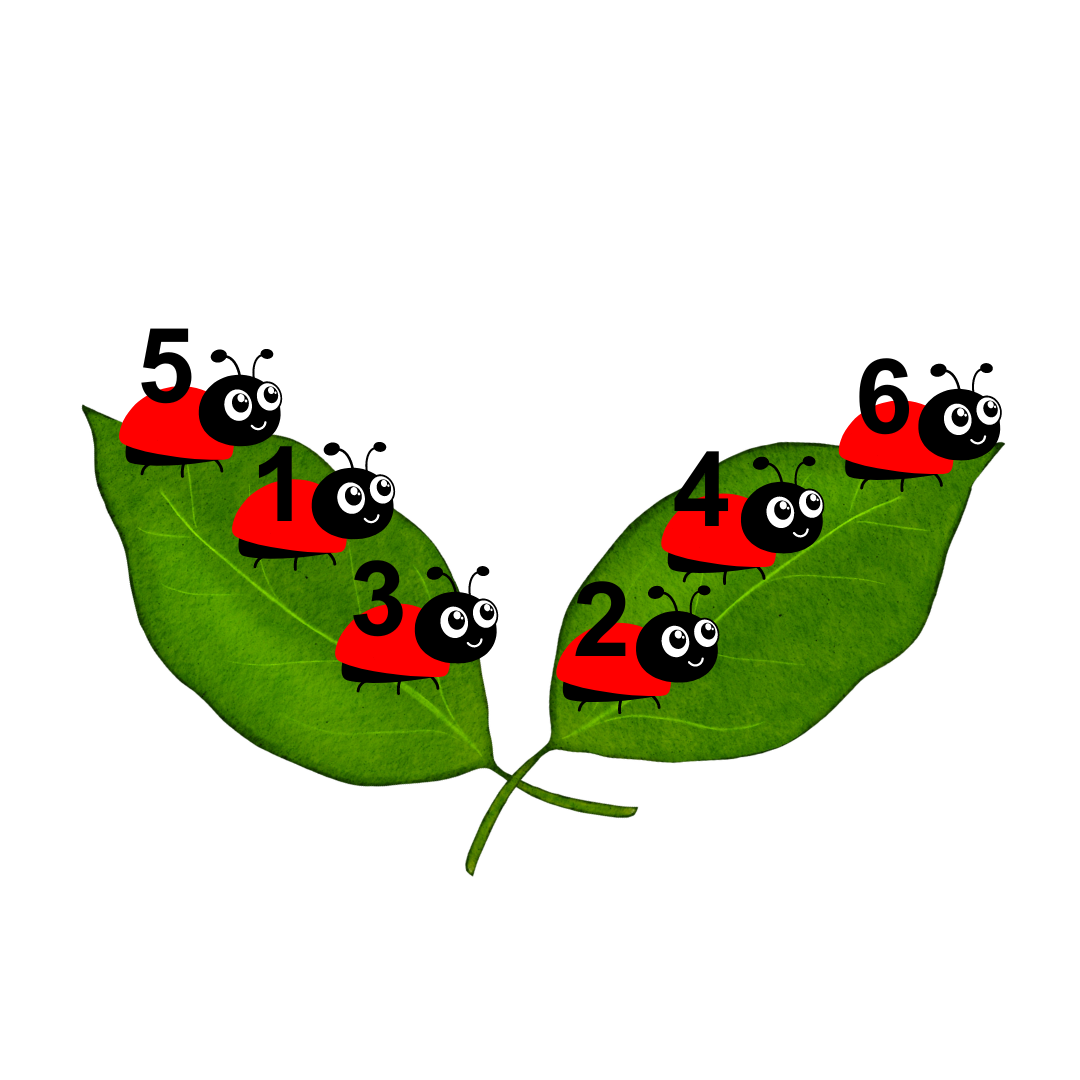
Ladybugs Don’t Add Up
Hints:
Start by exploring a simpler version of the problem.
The best solution when using only two leaves is:
-
(1, 2, 4, 8)
-
(3, 5, 6, 7)
This setup allows you to represent every number up to 15 using at most one number from each leaf. How can you build on this when adding a third leaf?
A good next step is to keep the first two leaves the same and place the numbers 9 through 18 on a third leaf. This lets you reach higher numbers with decent coverage.
To improve this further, make small adjustments:
-
Add 22 to the first leaf: (1, 2, 4, 8, 22)
-
Expand the second leaf with: (3, 5, 6, 7, 19, 20, 21)
This configuration reaches all numbers up to 22. With a few more minor changes, it’s possible to extend the range to 23, which is the best known solution for this setup.
Exploration:
How do things change if you use only even numbers? How do things change if you use only
odd numbers? What happens if you use more than three leaves?
Solution and Exploration:
Working with three leaves is significantly more complex than working with just two, but a few simple strategies go a long way.
Two Powerful Leaf Strategies
There are two particularly effective patterns for placing numbers on a single leaf:
-
Powers of 2 – e.g., (1, 2, 4, 8, 16, …)
These are useful because powers of 2 combine in a unique way to create a wide range of sums without overlaps. -
Consecutive sequences starting from a midpoint – e.g., (5, 6, 7, 8, 9, 10)
This pattern gives compact coverage of a dense range.
Step-by-Step: From Two Leaves to Three
Let’s build on the best-known configuration for two leaves:
-
Leaf 1: (1, 2, 4, 8)
-
Leaf 2: (3, 5, 6, 7)
This setup can generate all integers up to 15 when picking at most one number from each leaf.
To extend this idea to three leaves, we can place the next consecutive numbers on the third leaf:
-
Leaf 3: (9 through 18)
This gives us:
-
(1, 2, 4, 8)
-
(3, 5, 6, 7)
-
(9, 10, 11, 12, 13, 14, 15, 16, 17, 18)
With a few strategic additions, we can improve the range:
-
Add 22 to Leaf 1
-
Add 19, 20, 21 to Leaf 2
So we get:
-
(1, 2, 4, 8, 22)
-
(3, 5, 6, 7, 19, 20, 21)
-
(9, 10, 11, 12, 13, 14, 15, 16, 17, 18)
This configuration allows us to generate all integers up to 22, which is quite close to the theoretical maximum for three leaves.
The Best-Known Solution for Three Leaves
According to mathematical literature on sum-free partitions, the best known configuration that allows you to reach up to 23 is:
-
Leaf 1: (1, 2, 4, 8, 11, 16, 22)
-
Leaf 2: (3, 5, 6, 7, 19, 21, 23)
-
Leaf 3: (9, 10, 12, 13, 14, 15, 17, 18, 20)
Only a few numbers (such as 11 and 16) were moved from the earlier version to reach this optimal result.
Beyond Three Leaves
-
Four Leaves: Best known maximum is 66, with this configuration:
-
Leaf 1: (1, 2, 4, 8, 11, 16, 22, 25, 40, 43, 53, 66)
-
Leaf 2: (3, 5, 6, 7, 19, 21, 23, 34, 35, 50, 51, 52, 63, 64, 65)
-
Leaf 3: (9, 10, 12, 13, 14, 15, 17, 18, 20, 54–62)
-
Leaf 4: (24, 26–33, 36–39, 41, 42, 44–49)
-
-
Five Leaves: Best known value is 196
-
Six Leaves: Unknown — this remains an open problem in combinatorics! Perhaps one of your students can contribute to solving it.
Even and Odd Numbers
-
If you are only working with even numbers, you can double every number from the standard solution.
-
All odd numbers can be placed on a single leaf, so using three or more leaves provides no advantage in that specific case.