A Community Initiative by Aapli Marathi Shala & Math Kangaroo California State Director, Ravikiran Karanjkar.
Math Kangaroo is one of the largest international mathematics competitions, inspiring students across the globe to think creatively and solve challenging problems. As the California State Director for Math Kangaroo, one of my goals has always been to make sure our students are not just registered; they are prepared, confident, and excited when they walk into the exam room. This year, with many first-time participants in our community, we felt a mock test could be the perfect bridge between registration and readiness. What started as a simple idea grew into a remarkable community event: 75 students from 6 different cities, enthusiastic parent volunteers, and inspiring presentations from high schoolers. Here is the full story of how we made it happen.
Planting the Seed: The First Message
It began with a simple message to parents: “We are thinking of having one mock test for registered students.” No elaborate plan, no confirmed venue, just an honest intention and a call for parent volunteers to help make it happen. The response was warm and immediate. Within days, Aapli Marathi Shala offered to co-host the event, a venue at Delta College in Mountain House was secured, and we were ready to open registrations. This is the power of a connected, motivated community.
Building Momentum: Communication and Registration
We announced the mock test across community WhatsApp groups with clear event details: free of charge, open to Grades 1 through 6, held at Delta College, Mountain House on February 21st. The registration form went live, and we set a threshold: once 30 participants confirmed interest, we would finalize arrangements. We quickly learned the value of staying responsive. A parent pointed out that no Grade 7-8 option was available on the form. Within minutes, we added it. This kind of real-time adaptability is what builds trust with parents and ensures no child is left out. The response exceeded all expectations. All 75 reserved seats were filled within 72 hours of opening registration, with students coming from six different cities. It was clear this initiative had struck a chord far beyond our immediate community.
Preparing Parents: Education Before Exam Day
One of our key goals was not just to prepare students, but to educate parents about the Math Kangaroo format and what to expect. Many families were participating for the first time and had little context for what the competition entails. Through our communication channels, we explained that the official exam runs for 75 minutes and that the mock test would mirror this format closely. We also clarified what students should bring (a pencil and a water bottle), what would be provided (question paper, answer sheet, and one rough-work page), and the check-in and exam schedule.
The goal was to eliminate surprises. When parents understand the format, they can help their children feel calm and ready. An informed parent is one of the most powerful assets a student can have.
Event Day: Organized, Punctual, and Community-Driven
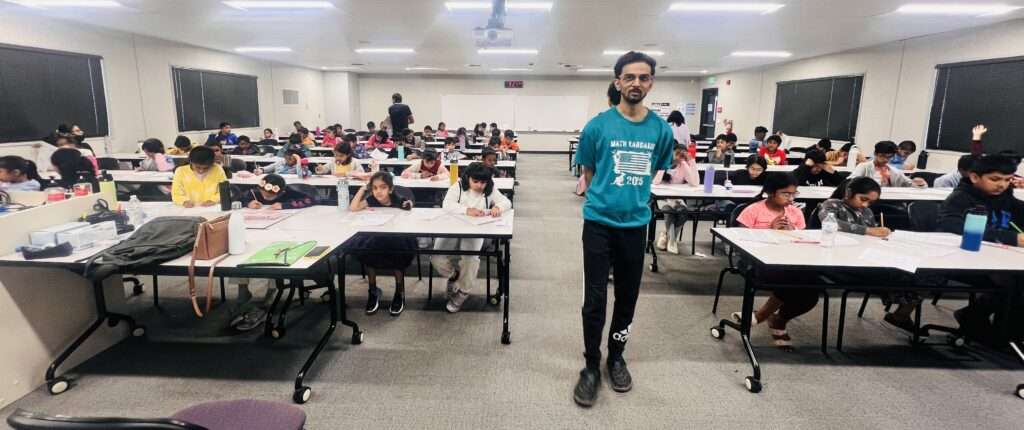
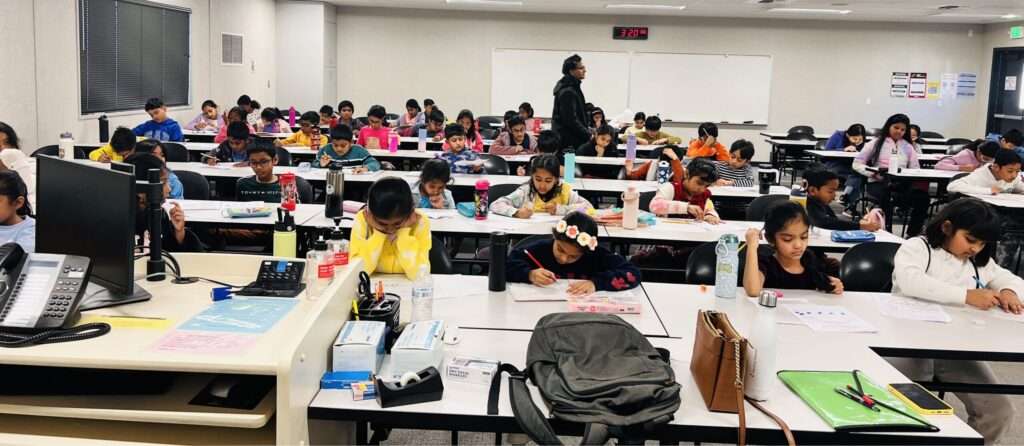
Check-in began at 2:00 PM, and the exam started promptly at 2:30 PM. The 15-minute buffer we built into the schedule proved its worth; it gave us time for smooth paper distribution and seating without rushing the students. A dedicated team of parent volunteers managed check-in, proctoring, and logistics with remarkable efficiency.
We are deeply grateful to our volunteer proctors: Sudhakar, Pavan, Prashant, Renuka, Anish, Balu, Suhasini, Mandar & Laxmikant. Their support was invaluable, and this event would not have been possible without them.
A Bonus Highlight: Presentations by High Schoolers and a Young Participant
One of the most memorable aspects of the day was a special segment featuring presentations by high school students. Three high schoolers took the stage to share their experiences and initiatives, covering three impressive programs: SkillsUSA, DECA, and Mission Med. Each presentation offered a window into the kinds of leadership, community service, and professional development opportunities available in high school.
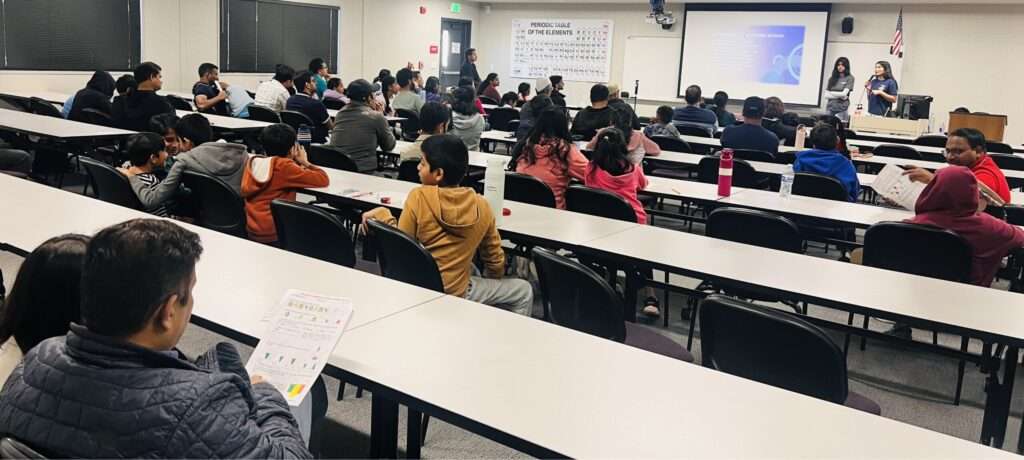
Adding a particularly inspiring touch, one of the mock test participants shared his own experience with Science Olympiad, showing the younger students in the room that you do not have to wait to get involved in enriching extracurricular activities.
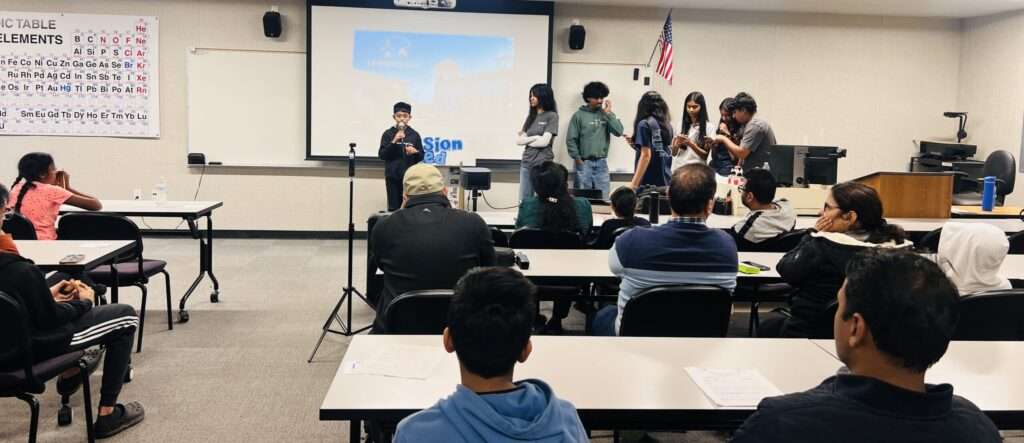
For parents, too, it was an eye-opening session about the extracurricular landscape and how early skill-building translates into future opportunities.
After the Exam: Answers, Feedback, and Next Steps
After the exam, answer keys for all grade levels were shared via WhatsApp groups and by email for those who could not attend in person. Most parents collected their children’s answer sheets on the day; six sheets remained uncollected, and parents were personally contacted to arrange pickup.
For families looking to continue practice at home, official Math Kangaroo resources are available. Sample papers for various grade levels can be found at mathkangaroo.org/mks/practice/pdf-exams (login required, nominal fee), and free sample questions are available at mathkangaroo.org/mks/practice/free-question-samples.
Key Learnings for Students and Parents
Based on the mock test observations and community feedback, here are some important areas to focus on before the main competition:
- Build stamina for sitting through a 75-minute exam: Many students, especially first-timers, found it challenging to stay focused and seated for the full duration. Parents can help by gradually building this habit at home: have your child sit down and solve a set of sample questions with a timer running, progressively working up to the full 75-minute window. This makes the real exam feel much more familiar.
- Each question has exactly one correct answer: A few students circled more than one option, either because they changed their mind or assumed multiple answers could be right.
- It is important for children to understand that every Math Kangaroo question has one and only one correct answer. Encourage them to think it through, commit to their best answer, and move on.
- Use the restroom before the exam begins: Several students needed a restroom break shortly after the exam started, which took time away from their solving window. Parents can make it a pre-exam routine to ensure children visit the restroom before entering the exam hall. Of course, restroom breaks are always permitted during the exam if urgently needed, but going in prepared means more uninterrupted time for answering questions.
- Keep the answer sheet clean: Some students were drawing or doodling on their answer sheets. Since the official exam answer sheets are scanned and validated by a computer, any stray marks can interfere with accurate scoring. Reinforce with your child that the answer sheet is only for marking their selected answers, and all rough work should be done on the separate rough-work page provided.
- Answers must be marked on the answer sheet, not the question paper: A few students circled answers directly on the question paper rather than on the answer sheet. Only responses marked on the answer sheet are counted. Practice this at home so it becomes second nature: read the question paper, do rough work on the rough-work page, and mark the final answer on the answer sheet.
- Both the question paper and answer sheet must be submitted at the end: Unlike the mock test where students could take their papers home, the official Math Kangaroo exam requires both the question paper and the answer sheet to be handed back to the invigilator before leaving. Please make sure your child is aware of this so there are no surprises on exam day.
- Finishing too quickly is a signal to double-check: A small number of students appeared to complete all questions within the first 10 minutes. Math Kangaroo questions are carefully designed to be challenging and thought-provoking; answering them all in such a short time is a strong indication that answers may not have been thought through carefully. Teach your child that if they finish early, it is a great opportunity to go back, re-read each question, and verify their answers before time is called.
The Community Response: Warmth and Gratitude
The response from the community after the event was humbling. Parents called it an “eye opener” for both students and families alike. Several noted that the mock test gave children a real understanding of the competition format, a chance to learn from mistakes before the actual exam, and a measure of genuine confidence. Others appreciated the way the event was organized: punctual, structured, and thoughtfully planned.
One parent summed it up beautifully: “This mock test gave kids a strong understanding of the format, experience, and a chance to learn from mistakes. And for parents, it helped us understand where to work on with our kids.” That, in essence, is exactly what we hoped to achieve.
Looking Ahead
The success of this event has opened exciting doors. Several organizations have already offered larger venues free of charge for next year’s mock test, which means we can welcome even more students.
We will also need volunteers for the annual California winners’ award ceremony, which typically draws over 400 families. If you are based in the Bay Area or Sacramento region and would like to contribute, we warmly invite you to sign up. Volunteers receive an official volunteering certificate from this international organization, a meaningful recognition for their time and effort.
Register as a volunteer here: https://form.jotform.com/251205875405152
This mock test was more than an exam practice session. It was a demonstration of what a community can accomplish when it comes together with a shared purpose. Thank you to every parent, student, volunteer, and high schooler who made February 21st a day to remember.
Thank you for reading. We look forward to seeing you at future Math Kangaroo events!
About the Author:
As the California Director for Math Kangaroo, Ravikiran Karanjkar is a dedicated community organizer active in Manteca and Mountain House, CA. His passion is cultivating young mathematical talent by ensuring students throughout the Bay Area and Sacramento region have access to quality competition preparation and resources. Additionally, he volunteers with Aapli Marathi Shala, contributing to cultural education and student enrichment.